
Universities and higher education institutions spend considerable sums of money in admissions and student recruitment processes, both to outreach prospective students as well as selecting the most suitable candidates for their programs. This requires not only proper criteria from marketing and admissions officials but better capacities to analyze data.
Student recruitment and college admissions processes test the capacity of their student administration system to handle vast amounts of information and queries from prospective students, organize their information and prepare a strong orientation programs through the different options a university offers.
That information shouldn’t be lost: teams should get feedback and benchmarks for the college administration to handle issues such as financial matters, special admissions, student engagement, marketing optimization, resource allocation and even curricular design.
For instance, experts from the University of Berkeley’s School of Information found that big data can help analyze patterns within an institution to personalize the learning process and measure student performance beyond test scores.
However, the use of big data and predictive analytics is key not only for statistics, academic and strategic planning. We’ve seen that people in charge of student affairs play a key role in shaping the information prospective students get when they are looking for higher education institutions, and using those insights to improve the academic and institutional processes.
Handling big data for student admissions information
Data science in higher education has plenty of uses. Let’s take the fictional case of one of the best universities of the world where prospective students from many different countries tend to make inquiries both in education seminars and online admissions programs.
The amount of information that admissions teams gets, is so large that they couldn’t handle it with a simple spreadsheet. The use of algorithms can help find out valuable data to improve situations that prevent potential students from choosing an institution.
What would happen, in theory, if:
-
A third of prospective students didn't have English as a first language and had reading and writing comprehension challenges. The data could be used to improve English language leveling programs as pre-sessional courses.
-
A quarter of graduate degree students were over 30, and they arrive with a family. Housing issues may prevent them from choosing a program over another one. The university could work on improving partnerships with residences and real estate companies.
-
Half the engineering prospects had good placement examination results but had deficiencies in calculus or algebra. The curriculum may be adapted for a foundation seminar.
Take social media and marketing, on the other hand. Input from online searches could be very valuable. According to Hanover Research,
-
98% of colleges and universities report having a Facebook page.
-
66% report maintaining some kind of blog.
-
47% of admissions professionals report using LinkedIn.
What if you could use social media data not just to spread the word, but to analyze the trends and patterns of what prospective students search online?
Imagine finding out in forums and keyword analysis that high school students don’t know the difference between a biomedical or a genetic engineer. The school may point out through marketing campaigns and online information what are the key features of each major.
Education Research Consultants Eduventures show that colleges can spend millions to recruit students using marketing collateral. Therefore, big data predictive analytics helps lower the acquisition cost per student.
For instance, an institution interviewed by Eduventures asserted that sophisticated use of predictive analytics allows the admissions team to scientifically assess which inquiries “are most likely to become applicants based on a variety of factors, including geographic location, anticipated college major, ethnicity, and source of first contact.”
“Armed with this information, the admissions team scores each inquiry’s likelihood of applying and gears its efforts and spending accordingly.”
Another interviewee found that, out of the high schools where they ran recruitment campaigns, 10% had a higher proportion of students they most wanted to enroll and used data to double their efforts.
However, there are reservations in using these processes and handling personal information for marketing. In that regard, The creators of the QS World University Rankings tries to draw the line “at marketing products and services that are more about profit than progress,” and states big data still has the ability to provide prospective students with more information and better options, enabling universities to improve both student performance and student recruitment.
In fact, for IBM’s EMC Corporation, higher education institutions have numerous student engagement points that can benefit from big data – from initial profiling all the way through to alumni giving.
The Student Engagement Lifecycle
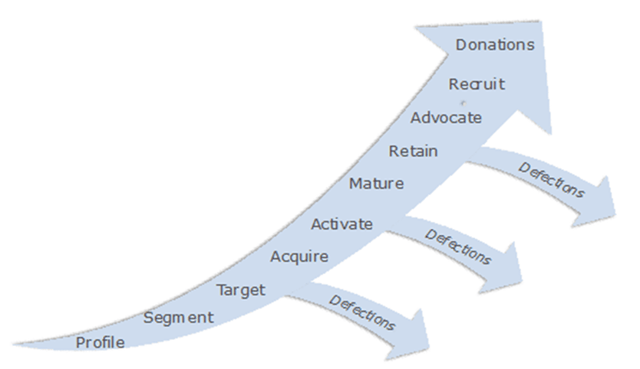
Source: EMC Corporation
There are educational benefits in the long run. Masterstudies.com tells that in refining the admissions process, predictive analytics based on demographic and behavioral data also supports increased graduation rates. “This allows universities not just to admit more appropriate candidates, but to better support them once they’re enrolled.”
Robert Miller, vice president for enrollment management at Centenary University, tells Universitybusiness.com: “Predictive analytics in particular allows enrollment managers to identify key variables in the likelihood of a particular student enrolling, allowing for a tailored recruitment strategy”. Enrollment management should look to “uplift modeling” that connects the institution’s actions to student behaviors that indicate an increased likelihood for college enrollments.

How are you capturing college admissions information? How do you use it to improve your educational processes?