In the age of digital transformation, communities are in a state of constant growth and their digital interactions are generating vast amounts of data, analysis of which can yield considerable improvements in the quality of student services. In this new environment, every type of institution will begin to adapt. However, higher education institutions (HEI) must consider it a priority and make the most of this new way of connecting with members of the community through the huge volumes of data that they have at their fingertips.
This data allows HEIs to evaluate the services they provide and understand the so-called “student journey”. Awareness of the activities that a student engages in as they pass through university not only allows administrative departments to attract, retain and guarantee the success of students, but also to create an efficient institution built around a central pillar: when institutions are focused on their students, they create better conditions in which to generate and retain income, invest in improvements, and compete in the ratings.
Main student concerns: data protection
Growth in internet data triggers alarm bells among HEI authorities regarding the correct use of data belonging to each member of the community, and this is of even greater importance in those countries which have modernized their legislation regarding use of personal data. However, during this time of transition, lack of coordination between universities means that historical data is retained often locally and in a fairly unregimented manner.
For multi-campus institutions, the challenge is to implement a system of data management that ensures information is protected while integrating it effectively into its plans for international expansion.
During this digital transformation, change management is a fundamental aspect of training for administrative teams and a key step in centralization of information. In order for it to be successful, HR departments must work closely with IT teams to supervise the data stored within departments across the university.
Student journey
According to consultancy firm PWC, the student journey is
“The end-to-end sequence of all the interactions that a student experiences throughout their relationship with a University – from the first time they hear about it at high-school, to completing their studies, graduating, continuing their learning, and keeping in touch as an alumnus.”
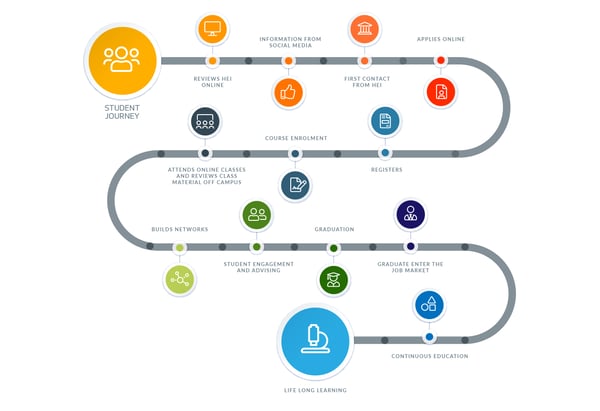
As such, adoption of this method of working is not restricted to a certain set of data but transcends the most important processes within the institution. Enrolment, facilities and financial planning, budgeting, forecasting and reporting, workforce and workload planning, and the planning of research funds are all key areas in which analytics can play an important role.
A HEI that is carrying out its work to an optimal level may secure a holistic overview of its students, obtaining targeted data that will ensure that the student journey flows smoothly from stage to stage and that, overall, it is a positive experience.
The five key elements of a student journey map
People:
Profiling that establishes the main characteristics of a given group of students, such as demographic data (gender, age, income level, etc.) and psychographic data (hopes, fears, goals, etc.). It may also incorporate students’ aspirations and what they hope to do after graduation.
Stages:
The phases through which the student passes before and after enrolment at a HEI. In general, the stages considered are discovery, evaluation, request, registration, retention and loyalty.
Points of contact:
The points at which the HEI may connect with prospective students; for example, the institution’s website, social networks, downloadable documents, applications and open days.
Attitudes:
What do new students think? This is a question which must be answered more than once. Students’ ideas and impressions need to be mapped prior to enrolment, following enrolment, during their course, while they are researching, as they motivate themselves to study, what frustrates them, etc.
Opportunities:
How might the university improve the student experience and increase registration numbers? Once the map is complete, identification of areas for improvement will be much easier.
Benefits of predictive analysis
1. Socialization:
Predictive analysis can be used to suggest socialization groups associated with student preferences and needs, both in terms of their tastes and their need for support in their academic work.
2. Learning:
Data analysis helps to gain an understanding of student preferences and teaching needs, as well as to understand and optimize learning and the environment in which it occurs, providing a personalized experience.
Requirements to boost the potential usefulness of data
In order to maximize the benefits offered by data analysis and to convert data into a true source of information, HEIs must ensure that:
- Data and information strategies are well defined and relevant;
- Data management policies and processes are effective (and address possible ethical / privacy issues);
- Systems and the data they capture are suitable for purpose and secure;
- Staff receive support in terms of digital literacy and relevant data management skills, and senior managers understand and provide appropriate support for the transition.
Conclusion
In a context of social change driven by new technologies, universities must adapt and really get to know their users. Data analysis is an important tool in this process. Analytical solutions already exist which, thanks to advanced AI algorithms, are able to map each of the points at which students require support, making the university experience both productive and memorable.