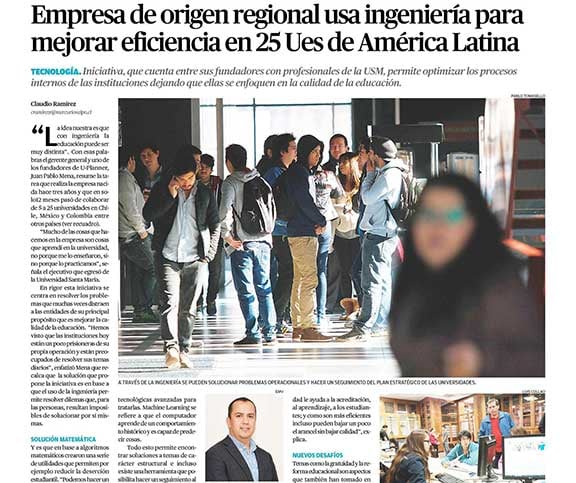
TECHNOLOGY. An initiative, founded by professionals from the USM among others, has made it possible to optimize internal processes in educational institutions, allowing them to place more focus and energy on the quality of education.
"We are of the belief that, with a little applied engineering, education could be very different” states the general manager and one of the founders of U-Planner, Juan Pablo Mena. He succinctly summarizes the work undertaken by the company for the last three years, work that has, in a mere 12 months, grown from providing services for 5, to 25 universities in Chile, Mexico and Colombia among other countries.
"Much of what we do at the company are things I have learnt at university, not in class however because I was never taught it, rather through practice” said Mr. Mena, an executive graduate of Universidad Santa Maria (St. Mary’s University).
Strictly speaking the initiative centers on solving problems that are largely distracting, deviating many institutions from their primary concern of improving the quality of education. “We have seen that educational institutions today are somewhat restricted and imprisoned by their own operating procedures and are more focused on daily issues” stressed Mena, emphasizing that the proposed solution is based on using engineering to solve problems that cannot be solved by people alone.
Certain mathematical algorithms form the base of the solution, providing tools that may for example, decrease student desertion. “We can analyze all the variables that influence student desertion covering socioeconomic and academic factors among others. To mention one, whether a student is male or female can have an important effect on his or her probability of dropping out. Women tend to drop out far less that men” commented Mena who is quick to point out the advantages of the method.
"For example you can’t have 10 thousand students and then say which ones will leave, you can’t predict that. However our algorithm does precisely that and can factor in hundreds of variables at the same time. It’s related to what today people call Big Data and Machine Learning” adds Mena.
Big Data is oriented on large amounts of information and, at that level, the advanced tech tools to process it. Machine Learning refers to when a computer learns from a history of conduct or behavior and as a result can predict events.
It all makes it entirely possible to find solutions to structural issues and even includes a tool for monitoring the institution’s strategic plan. “We cover key areas such as certification, academic planning, student retention and student learning" he commented.
The pressing need to apply engineering to education is what led to the founding of the initiative: “What does this mean? In the same way we teach people to engineer in industrial, automotive areas and others, we would also like to apply it in education, and in such a way to ensure all good practices exercised at an institution are transmitted and applied in all said institution’s remaining areas” explains Mena.
And on that note, he tells us that using metrics and numbers as a fundamental part of decision-making, prevents improvisation. On the contrary, using this method can have a big impact.
"For example, we have a local client that decreased its use of infrastructure by 30%. What did they achieve by that? They managed to free up a large amount of rooms previously in use that they simply don’t need now; they were more efficient in designating classrooms. All the resources they saved were invested in quality, which in itself helps greatly with certification, learning and benefits the students; being more efficient means they can even lower tuition fees and lose none of their quality” further explains Mena. Issues such as free tuition and the oft talked about educational reform are aspects that have also been taken into account in operations. “Free tuition lowers generated income per capita for each student enrolled at the institution in question. As they make less money these same institutions are obliged to be more efficient, but they must also improve on quality otherwise they will no longer be competitive” the engineer points out, indicating an aspect that has been left out of the general debate.
"The discussion of coverage, free tuition, equality and quality is a little handicapped because no one has added that one crucial element to the equation; efficiency. If you’re an efficient institution you don’t need state provided resources, and if Chilean society as a whole is paying a lot of tax in benefit of their children’s education, who monitors and verifies these resources are being used efficiently?” concludes Mena.
"In the same way we teach people to engineer in industrial, automotive areas and others, we also want to apply it in education"
Juan Pablo Mena General Manager of U- Planner www.u-planner.com
AN EXPANDING INITIATIVE
U-Planner currently has 25 clients in all Latin American, five of which are in Chile. It is also in talks with nigh on 50 more institutions interested in one of the 17 products the company has on offer.
"80% of our income comes from outside Chile. Of that 80% half comes from Mexico. Here we work with clients such as Universidad Catolica (Pontifical Catholic University of Chile). In Mexico we work with the UVM (Universidad del Valle de Mexico) with 130 thousand enrolled students. So it’s hardly an initiative with little impact” said Mena, who stresses the importance of local engineering abroad. “In Chile we concentrate a large part of good quality education as compared to the rest of Latin America. In fact, the 2030 engineering program started by CORFO (Corporation for Promoting Production) is an example the rest of the continent is looking to, because Chilean engineering is widely acknowledged for its quality, amplified further still by the aforementioned program many are paying attention to” emphasizes the executive as he recalls his first approach to North America.
"When we arrived in Mexico with our Chilean company nobody knew who we were. I remember telling them: give me your data and I’ll calculate whatever you want to know related to learning, operations and planning. We were hired", Mena stated.