Even though the use of video is not new when integrating technology in the classroom, the use of live streaming is turning the tables in universities and colleges, both in the learning process, campus management and student recruitment.
QS digital solutions predicted, as a marketing trend for 2017, an interesting evolution of live streaming and video. They recall that Facebook has adapted its application to make live videos much more prominent.
“Live streaming may have been around for a while, but with the force of the world’s largest social network behind it, 2017 may really be the year it takes off.”
Why now?
Just imagine: you manage a college campus for 8,000 students and a renowned author, academic and Nobel prize winner is getting an honorary Ph.D., where he will discuss the future of economics.
The capacity of your auditorium is 200 people. However, the entire department of economics asked its 1,000-student body to attend the conference and submit an essay.
It isn’t a problem. These special events are not only recorded but streamed live on your university website. Not only that: 15,000 people watch the conference on its YouTube channel.
This is a trend for many universities
One of the best cases where streaming plays a key role is the University of California at Berkeley, running webcasts of both lectures and talks by experts.
In fact, Times Higher Education recalls the use of social media for live streaming, using Periscope and Twitter. For instance, a professor of anthropology at University College London (UCL) attracted 2,700 views for a conference broadcast via mobile phones.
The status of live streaming in higher education
Wowza Media Systems ran a benchmark survey of live streaming on campus from 350 universities worldwide. They found out that streaming is a top priority for schools and have become more frequent.
Live streaming works beyond the classroom, as they use smaller mobile streaming units. Most schools have video, networking and IT specialists onsite, as streaming has become part of their everyday priorities.
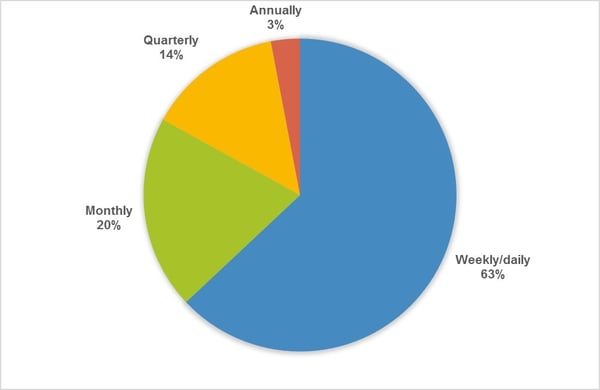
Regarding how often does the university stream live video on campus, 2 out of 3 schools reported live streaming on a weekly or daily basis.
 On the other hand, the types of streaming activities vary from one college to another. Most higher education institutions use live video streaming for speakers, concerts and events, followed by commencement addresses.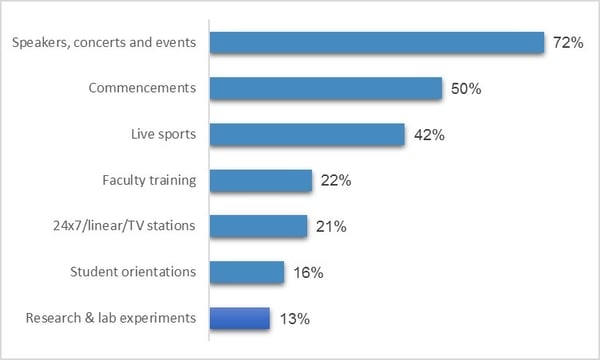
Is streaming changing the future of college education?
The portal eLearning Industry says that using live streaming in education, “students will be able to watch the experts in their field as they solve problems in real time.”
- Changes teaching as students can watch experts in their field solving problems in real time.
- Reduces costs for the student and the university.
- Fosters interaction and collaboration beyond the classroom.
- Promotes a diverse set of topics on the curriculum.
- Leverages the use of mobile devices for learning.
Learning applications
The use of streaming information technology has several benefits for the learning process.
Academics from the University of Colorado at Colorado Springs have evaluated the benefits of providing archived lectures to students in math. They found that the presence of these talks added “significant value to the learning process, with notable improvements in the perceived student performance and overall experience in the class.”
Scholars from the Swinburne University of Technology and Deakin University have studied the use of online tools, and found that live streaming in blended learning helped “engage off- and on-campus students in real time and enhances the off-campus experience by incorporating synchronous activities in addition to the usual asynchronous interactions.”
However, they find that there is a challenge to integrate and manage these technologies appropriately throughout the course.
Streaming performance metrics
A concern among educators and administrators with the use of video was how to use it not only to stream a class or a lecture but to get insight from viewership or college students preferences.
A key example is Netflix. Fortune explains how the use of data analytics helped the movie streaming giant prepare and program the most accurate and relevant films and TV shows in accordance with customer preferences.
Can this happen with educational content? It has been going on for a while. eLearning Industry explains that streaming can improve the way colleges gather performance metrics.
“With this, administrators will be able to create and test new methodologies conducive to the 21st-century student, who does not learn via traditional teaching methods.”
Streaming platforms can include tools that allow teachers and administrators to detect students’ preferences and requirements, and customize the online learning experience for the student. “They will also be able to automatically assess students’ knowledge and
College marketing and recruitment processes
Just as Artificial Intelligence is helping prospects introduce themselves into a more in-depth college experience before enrolling, the use of streaming helps both prospective students and alumni get acquainted with the latest that’s going on at the university.
QS Digital Solutions shows how live-streaming is contributing to promote a college experience, with campus tours to prospective undergraduates and free access to lectures and courses.
“For lesser known, younger institutions without the reputation built up by their older counterparts, it offers a way of competing. It’s also great for international students worried about how teaching methods and student life will differ from their home countries”.
QS adds that the key to
Upcoming Challenges
To develop this type of higher education technology, colleges not only need to invest in applications but in habilitating professors and staffing into the use of these applications and its integration into their curriculum.
A report by Wainhouse Research shows that, among the success factors of streaming, lies a thorough understanding and application of multimedia principles to pedagogy, building good foundations for learners, investing in professional development and getting top-down support to educators.
On the other hand, colleges face some barriers. Wainhouse underlines the attitude or (lack of) proficiency of teachers with technology, and the extra time that a scholar may need to prepare a particular class.
 Does your university use video streaming for classes or events? How?