Learning to use and embrace higher education technology is one of our followers’ pressing concerns in strategic planning. In fact, implementing a new school management solution requires an extensive nurturing process across campus. For that, you need to identify who on your team is more likely to embrace it and empower them to nurture their peers.
When you subscribe to our blog, we ask you about some of your major concerns.
One of our readers replied that his major strategic planning problem was “how to get highly experienced faculty and administrators to learn to use and embrace various technologies creatively in teaching and in managing in smart ways that are not yet conceived.”
“Today, all of what I said has become part of everyday reality. I am concerned about encouraging smart and innovative thinking with a penchant for ‘what if thinking.’"
It’s a serious issue. Implementing new technology in the workplace – especially in an educational institution – involves nurturing those who will be involved in it on a daily basis.
The technology adoption lifecycle
Those who’ve managed innovations know about the adoption lifecycle. Geoffrey A. Moore used the innovation lifecycle to understand the adoption of information technology in the workplace.
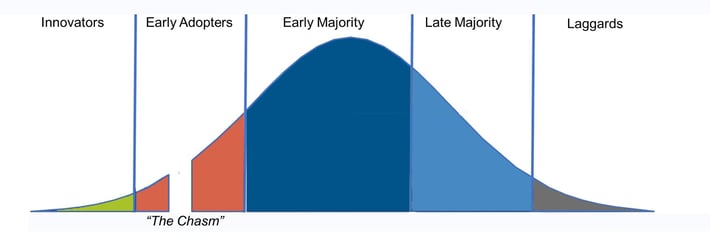
- The innovators detect a trend and follow it, and adopt technologies that don’t always succeed in the end.
- The laggards, on the other hand, are the last to integrate and are comfortable with legacy applications.
- In between, there are a plethora of attitudes toward technology.
Does this resonate with your higher education team?
Do you know the movie “Hidden Figures,” the story of three African-American mathematicians that contributed to the United States’ space program, but were away from the limelight at the time?
The part that caught my attention in light of our reader's concern was the story of Dorothy Johnson Vaughan.
She was the acting supervisor of a pool of female computers, running manual calculations for rocket launches and trajectories. But in the early 60s, her entire field was threatened by the introduction of IBM computers.
What did she do? She taught herself and her team the programming language of FORTRAN used on IBM machines, and taught her staff to run these machines. Later, she headed a programming section of the Analysis and Computation Division at NASA’s Langley offices.
She embraced a major breakthrough in information technology at the time and empowered her staff to leverage this as a new way to do their work, rather than a threat to their legacy computing processes.
Dorothy was a genius. However, rather than an innovator, she was a textbook definition of Geoffrey A. Moore’s early adopter:
- She was an opinion leader.
- Her input empowered her as a reference to her colleagues.
- She became a peer educator.
Learning to embrace technology for education: the main barriers
So, how to get highly experienced higher education faculties and administrators to learn to use and embrace various technologies creatively and smartly?
A Deloitte Touche Tohmatsu CIO Survey shows that the 10 most significant barriers to implementing a new system are:
- Resistance to change
- Inadequate sponsorship
- Unrealistic expectations
- Poor project management
- Case for change not compelling
- Project team lacking skills
- Scope expansion / uncertainty
- No change management program
- No horizontal process view
- IT perspective not integrated
So, if we have a project team lacking skills and motivation, with inadequate sponsorship, there is going to be resistance to change.
A critical one to disseminate that change is stage two: “building a powerful coalition,” where you must convince people that the change is necessary.
Leaders need to be supported visibly by a representative of the institution, building a team of influential people for different tasks. This includes informal leaders in the university, who are able to ask for an emotional commitment and make sure that this change unit integrates various departments and levels in campus.
That is what Dorothy Vaughan managed to run.
But how does a school administrator software handle this in the 21st century?
Nobody can properly train an entire staff spread out at a large university campus without internal support.
That is why some of us use the “Train the Trainers” method: with the college or university, we select specific people for extensive training in our applications, developing several “delegates” responsible for subsequently training their colleagues.
We create our own Dorothy Vaughan.
The importance of this method is that we qualify those who are most motivated to learn about these applications so they can return to their different departments, demonstrate and provide unit training to their peers, and share their expertise in a variety of ways, such as peer tutoring.
What’s more important, this is sustainable after members of the original team leave.
Creating a team to embrace change
We suggest our colleague to identify and build a coalition of peers valued enough to help him promote these changes.
That way, you can follow up your team gradually through this adoption curve. This is a natural process, and people gradually get on board along the way following the example of their colleagues.
Eventually, as people become more aware on the uses or benefits of higher education technology – either in the classroom or the admissions office – the early adopters will turn into the early majority and so forth, promoting a virtuous cycle.

Does your institution have problems implementing new technologies for education?