
Two-thirds of higher education executives feel that institutional metrics are very useful for success in university’s management, according to a Thomson Reuters report.
What slowly started in middle 1990’s is nowadays a widely implemented tool in public and private universities around the world. “While some institutions already had a long history of strategic planning – Hanover Research explains – many other institutions saw strategic planning as an opportunity to adopt business management approaches to issues such as assessing the competitive environment, tracking progress toward goals and resource allocation.”Now, until today implementing strategic planning in higher education institutions is a complex issue, where effectiveness depends on the capability of planners to determinate the right metrics for the right variables that affect goal achieving. In order to simplify this process and make it more comprehensible for every internal stakeholder in a university, academics and experts have been analyzing how universities have been applying this tool and recently the work of professor Dawn G. Terkla have been quoted by several journals and researchers.
According to the Association of Governing Boards of Universities and Colleges, professor Terkla developed an extensive survey about the main metrics that higher education institutions use to measure their performance.
The study showed that most higher education institutions in the United States, use basic and well-proved KPIs such as:
- - Financial results
- - Admission
- - Enrollment
- - Satisfaction
Also, they apply some specific metrics such as:
- - Student engagement
- - Graduation
- - Student retention rates
- - Academics
- - Research
- - Plant investment rates
 Source: agb.org
As we can see, there are two different trends of metrics – one about management and one about academics – that run through parallel tracks and don't interconnect too often, reflecting that higher education management means to successfully balance two different worlds – two different perspectives – and to align them with a common goal: Excellence. A major task that requires precision and deep knowledge about metric’s efficacy.
The right KPIs
Related to this, professor Karen E. Hinton (Ph.D.) explains that “in the past, institutions have fallen back on the use of the older and more traditional assessment measures to demonstrate their effectiveness and some of these do fit the situation. Such measures as graduation rates, retention rates and percent of faculty with terminal degrees in appropriate disciplines do relate to the parts of the institutional mission that concern supporting education to the institution’s target student population. However, some other types of institutional goals are trickier to measure. A non-specific institutional goal is a goal that requires interpretation to determine its measurement.”
“For example – Ms. Hinton adds – most institutions currently include institutional goals about technology, either in the learning process or as a way to reduce cost and bureaucracy, or both. The question is: based on the wording of the goal, how does an institution prove this use of technology is occurring and that it is having positive results? Just spending money on technology does not prove it; neither does it show the number of staff engaged in training in the use of technology. The answer to the question is: what did the institution specifically have in mind when it set the goal? In other words, what did the institution expect success to change?”
Professor Terkla’s study shows well-evaluated general metrics, that can fit in every higher education institution, but it doesn’t mean that universities can’t develop their own metrics according to their realities and – even more important – to what they really want to achieve as an institution.
Cornell University, for example, has developed a strategic planning composed by a mix of different variables, which have been defined as “Core Metrics”:
Headcounts:
- - Students, by Degree Objective
- - Employees
Endowment & Gifts:
- - Endowment: Cornell & Ivies
- - Gifts Received
- - Faculty Holding Endowed Chairs
Undergraduate Tuition & Financial Aid:
- - Tuition: Cornell and Peer Institutions
- - Financial Aid (CU Grant)
- - Student Debt at Graduation
- - Net Cost of Attendance
Selected Rankings:
- - US News Undergraduate Program rankings
- - Number of Fields in the Top Ten of Their Disciplines
Metric constants:
Now, according to a Thomson Reuters report, what determines which type of metrics universities should choose for their strategic planning are three constants: accountability, competition and strategic use of resources. “Whether they (higher education executives) are meeting compliance regulations, identifying strategic needs and opportunities, or scanning a data dashboard to track progress, they are finding that measurement is central to their responsibilities,” the report says.
Besides, the metric management means important challenges for a higher education institution. Thomson Reuters explains that “finding, generating and reconciling the necessary data was described as a complicated and time-consuming process for universities.”
“So institutions seek data from a broad and varied array of sources, including data generated in-house and external databases from government, associations and commercial providers (…). But data are often “too global” and don’t easily break down across disciplinary or geographic lines,” the report adds, so institutions must be prepared for this kind of information gathering tasks.
Thomson Reuters also proposes his own list of most common higher education metrics, which share several KPI’s with other lists (such Terkla’s and Cornell’s):
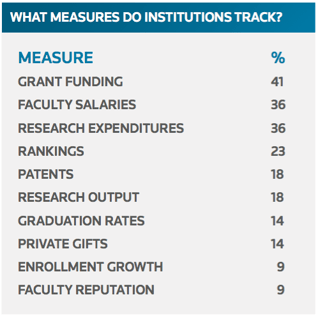 Source: http://researchanalytics.thomsonreuters.com/essays/
How are your university’s metrics doing so far? Should universities share metrics to facilitate benchmarking? Please share a comment.
